Tahajjud vs Taraweeh
Every Ramadan the question returns: I prayed Taraweeh at the mosque — is that my Tahajjud too, or do I still need to wake up in the last third? The honest answer is that the two names describe the same night prayer from different angles, and the sources use them with a logic worth understanding. Settle the concepts here; tonight's times are in the tahajjud calculator.
The short answer
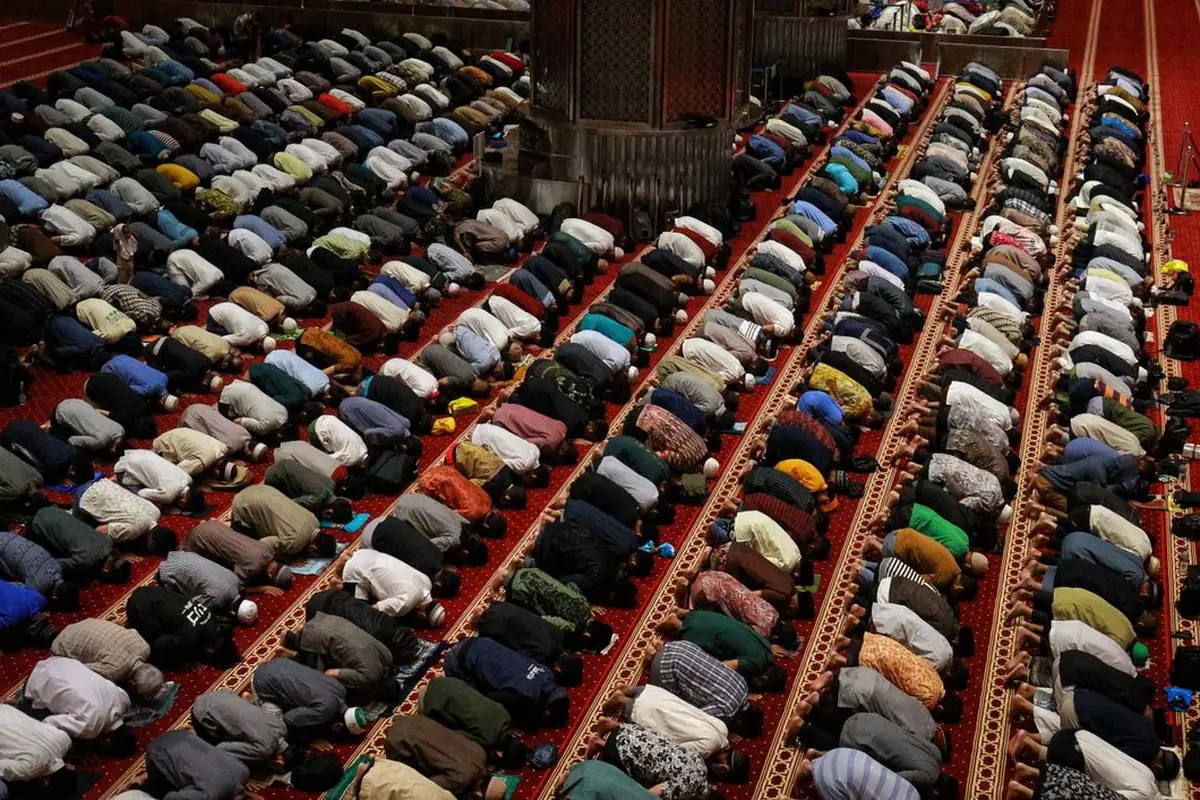
Taraweeh is the night prayer (qiyam al-layl) of Ramadan, prayed in congregation after Isha. Tahajjud is the night prayer especially in its classic form — after sleep, above all in the last third of the night. They are not two separate obligatory-style rituals competing for the same hours; they are two names that grew around one act of worship. In Ramadan, the prayer the congregation performs after Isha is called Taraweeh; the prayer a person rises for later in the same night is called Tahajjud. Many scholars treat the names as describing emphasis and timing rather than two different prayers — which is why you will also hear Taraweeh itself called qiyam, and late-night Ramadan prayer called both.
Where Taraweeh comes from
Aisha reported that one night in Ramadan the Prophet ﷺ went out in the middle of the night and prayed in the mosque, and men prayed behind him; the gathering grew on the second and third nights until the mosque could barely hold the people. On the fourth night he did not come out for it, and in the morning he explained: your presence was not hidden from me, "but I was afraid that this prayer might be made compulsory, and you might not be able to carry it out" (Sahih al-Bukhari 924).
So the congregational night prayer of Ramadan is prophetic in origin — and its non-obligatory status was protected by the Prophet ﷺ himself. The standing congregational form the ummah knows, gathered behind a single reciter, was organised in the caliphate of Umar ibn al-Khattab (reported in Sahih al-Bukhari). The name Taraweeh — from the rests (tarwihah) taken between sets of rak'ahs — belongs to that congregational Ramadan shape.
One prayer or two, in practice?
For the worshipper, the practical map is simple:
- Taraweeh after Isha — the congregation's prayer: communal, unhurried, with the Quran recited across the month.
- Tahajjud in the last third — the solitary prayer: after sleep, in the hour of the descent hadith (Sahih al-Bukhari 1145; Sahih Muslim 758), with dua at its centre.
- Both are qiyam al-layl, the standing of the night — the umbrella term our comparison with Qiyam al-Layl explains in full.
Praying both is the pattern of the keen, especially in the last ten nights — and our Ramadan guide maps how to pace them across thirty nights without burning out by night twelve. Praying only Taraweeh is complete and rewarded; nobody is deficient for sleeping the rest of the night. And the Prophet's ﷺ own Ramadan nights, as Aisha described them, never exceeded eleven rak'ahs in total, in Ramadan or out of it (Sahih al-Bukhari 1147) — a standing rebuke to the idea that Ramadan worship is measured by exhaustion.
The Witr question that follows
If you pray Witr with the congregation at the end of Taraweeh and then rise for Tahajjud later, do not repeat Witr: there are not two Witrs in one night. Pray your Tahajjud in pairs and let the earlier Witr stand as the night's seal. If you habitually rise in Ramadan's last third, some prefer to leave the congregation's Witr and pray it at the end of their Tahajjud instead — both patterns are practised; the details are in Tahajjud and Witr.
Frequently asked questions
Is Taraweeh the same prayer as Tahajjud?
In substance, they are the same night prayer viewed from two angles: Taraweeh names it as Ramadan's congregation prays it after Isha; Tahajjud names it in its after-sleep, last-third form. Scholars discuss the labels, but no school treats them as two unrelated rituals with separate obligations — both are voluntary night prayer, and both are qiyam al-layl.
If I pray Taraweeh, do I still need to pray Tahajjud?
There is no "need" — both are voluntary. Taraweeh alone is a full and rewarded Ramadan night. Rising in the last third adds the specific hour the hadith singles out for dua and forgiveness, which is why many people add a short Tahajjud on the nights they can — above all in the last ten nights, when Laylatul Qadr is sought.
Can I pray Tahajjud at home after praying Taraweeh at the mosque?
Yes — that is exactly the pattern of countless Ramadan nights: congregation first, solitude later. Pray in pairs, make your dua, and do not repeat Witr if you already prayed it with the congregation. If Fajr is near, shorten the prayer rather than skipping it; two rak'ahs inside the last third are complete.
Why is Taraweeh prayed right after Isha if the last third is better?
Because congregation has its own wisdom: the whole community, including those who cannot rise at night, stands together in Ramadan's prayer at an hour everyone can reach. The last third remains open afterwards for those who seek it. The two timings are not rivals; they are the same door at two hours, and Ramadan is generous enough to hold both.
Ramadan or not, the last third has a start time tonight — find yours.
Open the Tahajjud Calculator